


Imagine you want to move a meaningful sum of Monero (XMR) and Haven (XHV) between your hardware wallet and a mobile app while minimizing address linking, IP exposure, and any accidental metadata leaks that could draw unwanted attention in jurisdictions with strict compliance practices. You need a flow that preserves custody, keeps view keys private, and minimizes surface area for attackers — yet you also want to swap between assets without trusting a centralized exchange. That everyday-but-high-stakes scenario highlights the practical tensions privacy-minded U.S. users face: convenience versus the residual risks created by software, network endpoints, and human operational errors.
This article compares the mechanisms, trade-offs, and limitations of using a privacy-first, multi-currency wallet that supports Monero and Haven against alternative setups. My aim is to sharpen a decision framework you can reuse: which components actually protect privacy (and how), where those protections break down, and what operational practices reduce risk. I assume you value non-custodial control and are comfortable with moderate technical steps like running Tor or bolt-on hardware integration.
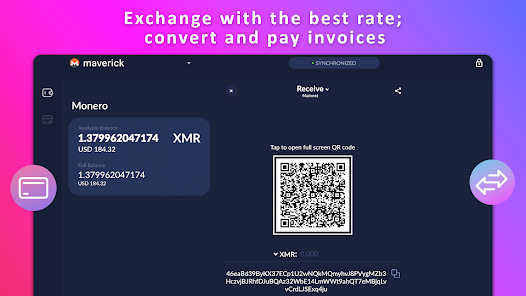
How Cake Wallet’s architecture maps to real privacy needs
To judge any wallet for XMR and Haven you need to separate three layers: custody, on-device security, and network anonymity. Cake Wallet, as a concrete example that supports XMR and Haven, draws clear lines across these layers. It is open-source and non-custodial, so private keys remain under user control; the private view key for Monero stays on the device. Device-level encryption makes the seed and wallet files inaccessible without your PIN or biometric via Secure Enclave (iOS) or TPM (Android). Those are strong technical controls, but they do not eliminate operational mistakes — e.g., insecure backups, screenshots, or using an uncertified APK on Android.
Network protections matter because even perfect key custody doesn’t hide that “someone sent money at time T from IP X.” Cake Wallet offers Tor-only mode and I2P proxy support and lets you point at custom remote nodes. That’s significant: if you run your own Monero node and pair it with Tor, you minimize leakage from node-operator metadata and ISP visibility. However, running a full Monero node is resource-heavy and not yet realistic for many mobile-centric users. For those who don’t run a node, trusting a remote node — even over Tor — is a residual privacy trade-off because nodes can observe patterns of RPC queries. The practical heuristic: stack endpoint privacy (Tor/I2P + custom node) with device-level encryption and hardware wallet integration for the best combination of anonymity and custody.
Monero (XMR) and Haven (XHV): protocol differences that matter for privacy
Monero is privacy-by-default: ring signatures, confidential transactions (RingCT), and stealth addresses obscure sender, receiver, and amounts on-chain. Haven Protocol (XHV) builds on Monero’s privacy primitives but adds an asset-like feature set that allows “offering” different asset types (e.g., synthetic dollars) within the protocol. That means the transaction mechanics are similar, but use cases diverge: Monero is primarily private money, while Haven targets users wanting private synthetic assets and a single-ecosystem experience.
For an end user, the important distinctions are operational rather than cryptographic. Subaddresses and private view keys in Monero let you compartmentalize receipts: generate a fresh subaddress per counterparty and the wallet will route incoming funds without revealing linkage through the blockchain. Cake Wallet supports subaddresses and keeps private view keys local, which prevents server-side correlation. Haven inherits these patterns but tends to have a smaller network and different liquidity characteristics, which affects how easily you can swap XHV for XMR or fiat-like assets without relying on centralized services.
Comparing privacy tools: Silent Payments, PayJoin, MWEB, and mandatory shielding
Bitcoin privacy is structurally different from Monero. Cake Wallet integrates advanced BTC privacy tools: Silent Payments (stealth addresses for Bitcoin), PayJoin v2 (a cooperative coinjoin that hides which input paid), UTXO coin control, and transaction batching. These reduce linkability on Bitcoin but require careful coordination and sometimes counterparty support. PayJoin is helpful when both sender and receiver support it, but it’s not a universal solution — many wallets and services still do not accept PayJoin transactions.
For Litecoin, Cake Wallet supports MWEB (MimbleWimble Extension Blocks), which offers optional privacy layers similar to a confidential transaction mechanism. For Zcash, Cake Wallet enforces mandatory shielding so outgoing funds originate from shielded addresses by default — preventing accidental transparent address leaks. That “default-on” approach is a strong usability win because defaults shape behavior: many privacy failures happen when users misconfigure wallets.
Hardware integration, Cupcake air-gapped solution, and operational practice
Hardware wallets meaningfully reduce key-theft risk. Cake Wallet integrates with Ledger devices and a bespoke air-gapped hardware wallet called Cupcake. Air-gapped signing is the most robust defense against remote compromise because the signing key never meets an online machine. But hardware alone doesn’t solve the whole problem: an attacker can still deanonymize you via network-level correlation, compromised nodes, or careless backup practices. Combine a hardware wallet for signing with Tor-only connections and conservative UTXO management to reduce cross-protocol leakage.
Operationally, use these heuristics: (1) treat view keys as highly sensitive — never export them to third-party services; (2) use subaddresses for every new relationship; (3) avoid address reuse and co-spending UTXOs from different provenance unless you want them linked; (4) prefer hardware signing when moving large sums; and (5) enable Tor-only mode when syncing or swapping. Those are straightforward steps, but they require discipline — the human factor is often the weakest link.
On-wallet swaps, NEAR Intents, and the privacy cost of convenience
Built-in swapping is a major convenience: Cake Wallet’s swap integration uses NEAR Intents to find decentralized routing among market makers, which reduces reliance on a single centralized exchange. That lowers custody risk compared with custodial exchanges. However, swapping still involves exposing trade intents to routing systems; some metadata — such as timing, size, and sequence — can be observed off-chain by market makers and relays. The right trade-off depends on threat modeling: if your adversary is a passive chain observer, decentralized routing plus Tor suffices; if your adversary can subpoena counterparty logs or control liquidity providers, swaps leak more than on-chain-only transactions.
So, if maximum deniability and minimal metadata are the priority, consider transacting on-chain first using native privacy layers (Monero/Haven) and only swap to other assets using privacy-preserving rails or through multi-hop, privacy-aware routing. If time and price slippage matter more, limited use of NEAR Intents is a pragmatic option — but keep in mind the increased exposure to off-chain counterparties.
FAQ
Does Cake Wallet make my Monero transactions completely anonymous?
No tool can guarantee absolute anonymity. Monero provides strong on-chain obfuscation; Cake Wallet preserves key custody and supports subaddresses and private view keys stored locally, which together greatly reduce linkage. But anonymity depends on your endpoint configuration (Tor vs. clearnet), whether you run your own node, how you manage UTXO/address hygiene, and human operational security. Treat the wallet as one strong layer in a defense-in-depth approach.
How does Haven Protocol differ practically from Monero for everyday wallets?
Haven uses Monero’s privacy primitives but adds internalized synthetic assets. Practically, that means similar transaction privacy but different liquidity and swap dynamics. Expect fewer market makers and possibly wider spreads for XHV; that affects how you convert to USD or stable assets. From a privacy perspective the two are comparable on-chain; from an operational perspective, swapping and liquidity are the key differentiators.
Is it safe to use built-in swaps for privacy-sensitive amounts?
Built-in swaps (NEAR Intents) reduce custody risk, but they introduce off-chain metadata exposure to market makers and routers. For small convenience trades they’re pragmatic; for large or highly sensitive transfers, split the operation: move funds on-chain using privacy-native flows first, then swap in smaller increments through privacy-minded relays or multiple counterparties.
What specific operational mistakes should U.S. users avoid?
Common failures: using clearnet connections (no Tor), reusing addresses, exporting private or view keys to third parties, keeping keys in cloud backups without encryption, and installing unofficial wallet builds. Additionally, be cautious with exchanges that require identity verification if your goal is strong privacy; on-ramps and off-ramps are often the weakest links.
Where the protections break down — and what to watch next
The model of defense-in-depth works well but has clear boundaries. Device-level encryption and hardware signing protect keys at rest and during signing; network-level protections (Tor/I2P/custom nodes) limit IP linkage; and privacy protocols like Monero/Haven shield on-chain data. Yet three systemic vulnerabilities remain: (1) endpoint trust — remote nodes still see RPC patterns unless you run your own node; (2) off-chain counterparties — swaps and liquidity providers can log timing and amounts; and (3) human error — backups, seed phrase handling, and app sourcing mistakes. The practical agenda for users is to reduce the probability distribution of these failures rather than chase unattainable absolute anonymity.
Watch these signals in the near term: improvements in mobile lightweight node tech (which would reduce reliance on remote nodes), broader adoption of PayJoin-like coordinated privacy in Bitcoin wallets, and any changes to regulations that affect on/off ramps or the legality of privacy tools. These trends would change the calculus for whether to prioritize swaps or on-chain-only flows.
Decision heuristics: a quick rule set for choosing a setup
– If custody and maximal on-chain privacy are primary: use Monero/Haven native flows, enable Tor-only mode, use subaddresses, and sign with an air-gapped hardware device. Run a personal node when feasible.
– If usability and multi-asset access matter: accept decentralized swaps (NEAR Intents) but compartmentalize amounts and split trades to reduce single-observation leakage. Prefer wallets that default to privacy-safe settings (e.g., mandatory shielding for ZEC) and zero telemetry.
– If regulatory exposure is your top concern in the U.S.: keep thorough operational logs of your own actions (not transaction logs exposed publicly), avoid mixing identifiable KYC-linked exchange flows with private-chain assets, and consult legal advice for large transfers.
For practical next steps, test your device setup: confirm Secure Enclave or TPM is active, enable Tor-only mode, and practice a small transfer using a subaddress plus hardware signing. If you want a single place to try these features with multi-currency support and built-in swaps, see the official distribution page for a secure install and the vetted app builds: cake wallet download.
